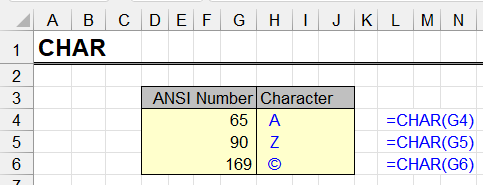
What does the CHAR function do?
This function converts an integer to the character that corresponds to it in the current ANSI encoding used by the operating system.
IMPORTANT: ANSI encoding is a collective concept - there are many of them (encodings), and the mapping table of numbers and characters will vary depending on what is specified in your operating system's registry.
CHAR function syntax
=CHAR(number)| A | B | C | |
|---|---|---|---|
| 1 | Code | CHAR | What it is |
| 2 | 65 | A=CHAR(A2) | Latin A |
| 3 | 97 | a=CHAR(A3) | Latin a |
| 4 | 34 | "=CHAR(A4) | double quote |
| 5 | 10 | ↵=CHAR(A5) | line break (visible with Wrap Text) |
| 6 | 169 | ©=CHAR(A6) | copyright |
| 7 | 256 | #VALUE!=CHAR(A7) | outside 1–255 |
Codes 128–255 depend on the system code page; here it is Windows-1252, the default for English Windows. For characters outside 1–255 use UNICHAR: =UNICHAR(8364) gives €.
The number must be from 1 to 255, otherwise the function will return a #VALUE! error.
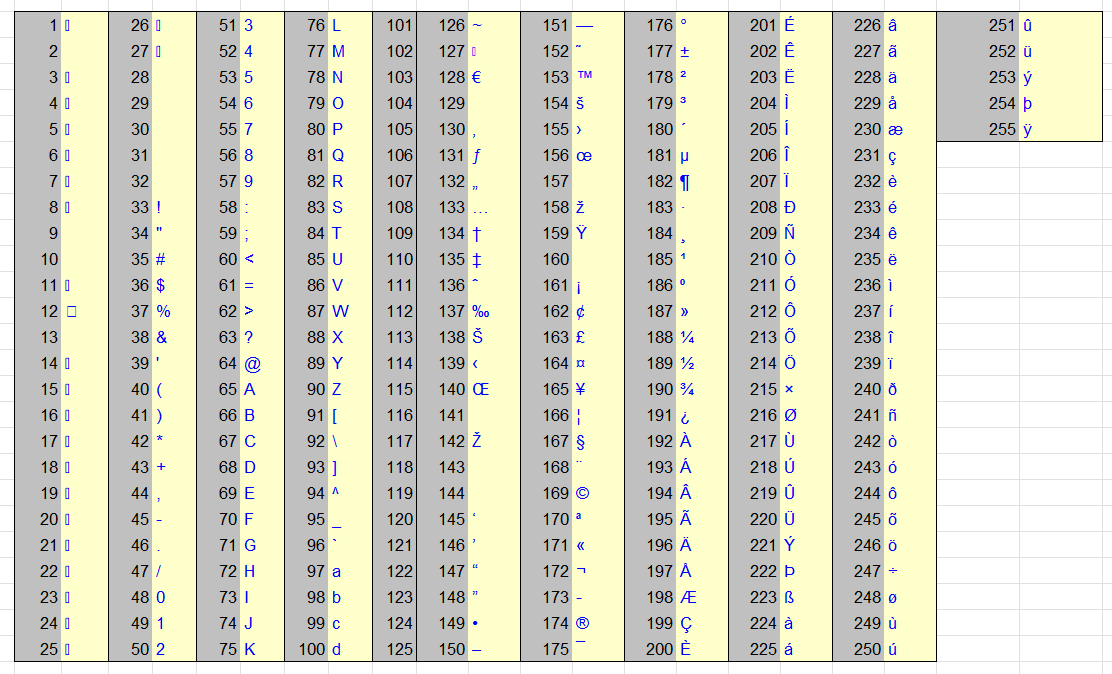
Character codes and their corresponding symbols
The table below will help you quickly navigate when you need rarely used symbols. The most in-demand ones are:
- line break character - 10
- ™ symbol - 153
- ® symbol - 174
- © symbol - 169
- guillemets - 171 and 187
- plus-minus sign (±) - 177
| A | B | C | |
|---|---|---|---|
| 1 | Code | Character | Typical use |
| 2 | 153 | ™=CHAR(A2) | trademark |
| 3 | 174 | ®=CHAR(A3) | registered |
| 4 | 169 | ©=CHAR(A4) | copyright |
| 5 | 171 | «=CHAR(A5) | opening guillemet |
| 6 | 187 | »=CHAR(A6) | closing guillemet |
| 7 | 177 | ±=CHAR(A7) | plus-minus |
| 8 | 10 | Line 1↵Line 2="Line 1"&CHAR(10)&"Line 2" | line break inside a cell |
A line break from CHAR(10) shows only when Wrap Text is on (↵ marks it here).
CHAR function examples
In addition to its intended use, the CHAR function can be used for other tasks in Excel, including those where it serves as an auxiliary function.
Create alphabet with CHAR function in Excel
A convenient way to avoid typing letters manually from the keyboard.
Depending on which alphabet you want to create in Excel, you'll need different number ranges.
For English, these are ranges 65-90 (uppercase) and 97-122 (lowercase).
| A | B | C | |
|---|---|---|---|
| 1 | # | Uppercase | Lowercase |
| 2 | 1 | A=CHAR(SEQUENCE(26,1,65)) | a=CHAR(SEQUENCE(26,1,97)) |
| 3 | 2 | B | b |
| 4 | 3 | C | c |
| 5 | 4 | D | d |
| 6 | 5 | E | e |
| 7 | 6 | F | f |
| 8 | … | … | … |
| 9 | Joined | ABCDEFGHIJKLMNOPQRSTUVWXYZ=CONCAT(CHAR(SEQUENCE(26,1,65))) | abcdefghijklmnopqrstuvwxyz=CONCAT(CHAR(SEQUENCE(26,1,97))) |
SEQUENCE(26,1,65) gives the codes 65…90, CHAR turns them into letters, and the list spills down. CONCAT joins them into one string. In older Excel: =CHAR(ROW(A65)) copied down 26 rows.
Letters with diacritics in the Windows-1252 code page take codes 192-255: À is 192, é is 233, ñ is 241, ü is 252. Keep in mind that this range is not letters only: 215 is the multiplication sign (×) and 247 is the division sign (÷), so a list built from consecutive numbers will include them.
Read more in the article: How to create an alphabet in Excel
Combinations with other functions
In combination with SEARCH, FIND, COUNT and ROW in an array formula, the CHAR function allows you to find alphanumeric characters in text.
It can also help extract or remove the last word in all cells.
Like the article? Help its author! Buy !SEMTools, it has lots of useful instruments to process text data.