| Function category | Text |
| Volatility | Non-volatile |
| Similar Excel functions | UPPER, PROPER |
| Similar !SEMTools functions | Change case |
What does the LOWER function do?
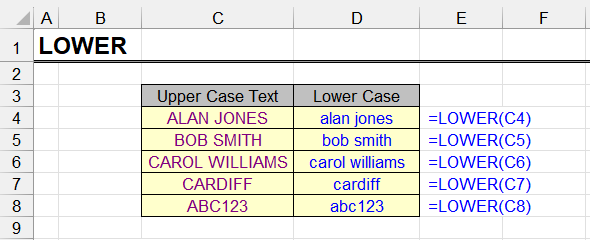
The LOWER function converts all letters in the value passed to it to lowercase. Everything that has no case, such as digits, punctuation and spaces, stays as it is. It works with any alphabet: “CAFÉ” becomes “café”, “ÜBER” becomes “über”.
It’s the opposite of the UPPER function, and together with PROPER they make up the trio of Excel case functions.
LOWER function syntax
=LOWER(text)
| A | B | |
|---|---|---|
| 1 | Text | LOWER |
| 2 | HELLO World | hello world=LOWER(A2) |
| 3 | SKU-AB12 | sku-ab12=LOWER(A3) |
| 4 | ÉCOLE | école=LOWER(A4) |
| 5 | iPhone 15 PRO | iphone 15 pro=LOWER(A5) |
Only letters change; digits, hyphens and spaces stay as they are. Letters with diacritics work too.
The only argument, text, is the text, the cell reference or the formula whose result you want to convert. In Excel 365, you can pass a whole range, and the result spills down automatically:
=LOWER(A2:A100)
| A | B | |
|---|---|---|
| 1 | Source | Spilled result |
| 2 | HELLO World | hello world=LOWER(A2:A5) |
| 3 | SKU-AB12 | sku-ab12 |
| 4 | ÉCOLE | école |
| 5 | iPhone 15 PRO | iphone 15 pro |
The result spills down for as many rows as the range has. Change a source cell and the spilled value updates.
LOWER: result and input format
Like all text functions, LOWER returns text. Numbers become numbers stored as text, dates turn into serial numbers (01/15/2026 becomes “46037”), and currency and percentage formats are lost. The result is easy to recognize: it is left-aligned in the cell. The details are in the PROPER function article.
LOWER function usage examples
Capitalize only the first letter in a cell
Suppose we need to make the first letter in each cell uppercase and the rest lowercase. The original table is entirely in caps.
Let me say right away that PROPER won’t work here: if a cell has several words, it capitalizes each of them.
To solve this, we’ll build a formula with the help of the MID function. The logic is simple: make the first letter uppercase and the rest lowercase.
You can get the first letter in different ways, with MID:
=MID(A1,1,1)
or with the LEFT function:
=LEFT(A1,1)
MID also extracts all letters except the first one (1000 here is a number that is definitely larger than the number of characters in a cell):
=MID(A1,2,1000)
The final formula combines these parts and processes them with UPPER and LOWER:
=UPPER(MID(A1,1,1))&LOWER(MID(A1,2,1000))
=UPPER(LEFT(A1,1))&LOWER(MID(A1,2,1000))
| A | B | |
|---|---|---|
| 1 | Formula | Result |
| 2 | =MID(A1,1,1) | J=MID(A1,1,1) |
| 3 | =LEFT(A1,1) | J=LEFT(A1,1) |
| 4 | =MID(A1,2,1000) | OHN SMITH. SALES MANAGER=MID(A1,2,1000) |
| 5 | =UPPER(MID(A1,1,1))&LOWER(MID(A1,2,1000)) | John smith. sales manager=UPPER(MID(A1,1,1))&LOWER(MID(A1,2,1000)) |
| 6 | =UPPER(LEFT(A1,1))&LOWER(MID(A1,2,1000)) | John smith. sales manager=UPPER(LEFT(A1,1))&LOWER(MID(A1,2,1000)) |
MID and LEFT give the same first character. MID(A1,2,1000) takes everything from the 2nd character on. The last two rows are the full formula in two equivalent versions.
Here is how it works on real data:
| Before | Result |
|---|---|
| NEW YORK OFFICE | New york office |
| JOHN SMITH. SALES MANAGER | John smith. sales manager |
| “QUOTED” TEXT | “quoted” text |
| 2 APPLES | 2 apples |
As you can see, this combination doesn’t always give the result you want. After all, it doesn’t capitalize the first letter of the cell, but the first character, which isn’t always a letter. And if a string has several sentences, the formula doesn’t recognize the second and the following ones and doesn’t capitalize them. How to find the first letter, not the first character, is explained in the article on how to make the first letter in a cell uppercase.
Is there a solution for several sentences? Yes! But not in standard Excel. My add-in offers it: select the cells and capitalize the first letters of sentences in one click:
Compare text regardless of case
LOWER is often used not to change the text, but to normalize it before a check. For example, the EXACT function is case-sensitive. To find out whether a cell contains any uppercase letters, compare it with its lowercase version:
=NOT(EXACT(A1,LOWER(A1)))
| A | B | C | |
|---|---|---|---|
| 1 | Text | Has capitals? | Equal to “report” ignoring case |
| 2 | report | FALSE=NOT(EXACT(A2,LOWER(A2))) | TRUE=EXACT(LOWER(A2),"report") |
| 3 | Report | TRUE=NOT(EXACT(A3,LOWER(A3))) | TRUE=EXACT(LOWER(A3),"report") |
| 4 | REPORT | TRUE=NOT(EXACT(A4,LOWER(A4))) | TRUE=EXACT(LOWER(A4),"report") |
| 5 | report 2 | FALSE=NOT(EXACT(A5,LOWER(A5))) | FALSE=EXACT(LOWER(A5),"report") |
EXACT is case-sensitive. If the text differs from its lowercase copy, it has at least one capital letter. Converting both sides with LOWER makes EXACT ignore case (the = operator already does).
The formula returns TRUE if A1 has at least one capital letter. More options are in the article on how to find uppercase letters in cells.
Convert a whole column to lowercase
The classic way is a helper column: type =LOWER(A2), fill it down, copy the result, paste it as values over the original and delete the helper column. Five steps for one simple operation, and the date and number formats in the column get lost along the way.
With !SEMTools, you select the column, choose Change case → lowercase, and the cells change right in place. No formulas to remember, type in or drag down:
LOWER function: other examples
LOWER seems so simple that it’s hardly needed. But here’s the paradox: its simplicity is exactly what makes it useful in so many tasks. Here are the ones on this site where LOWER helps:
- Count words in cells
- Count characters in Excel cells
- Extract letters from text
- Remove punctuation in Excel
- Find certain words in cells
- Find repeated words in cells
- Find text characters in Excel cells
Change text case in whole columns right in place: lowercase, UPPERCASE, Proper Case or sentence case, without formulas or helper columns.
!SEMTools solves this and hundreds of other text tasks in a couple of clicks!
Summary: when to use LOWER
I hope you found what you were looking for on this page and now know how LOWER works. Use it inside formulas: to normalize text before comparing it or as part of a bigger formula. To simply convert a column to lowercase, a formula is the long way round: helper column, fill down, paste values. !SEMTools does it in place in a couple of clicks.